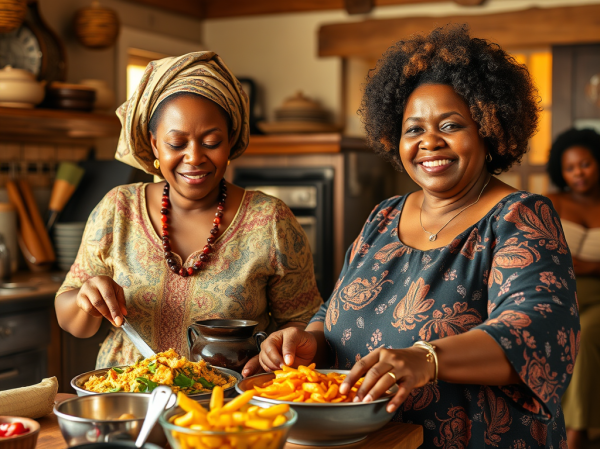
Healing the Mother Wound; What I learned from 2 Mothers-in-Law

a book excerpt: Veiled & Redeemed

Mothers mold us—not only in the womb but also through every interaction we have with them. British psychoanalyst Donald Winnicott once said, “There is no such thing as an infant—only an infant and their mother.” Our sense of self, he believed, is built from the earliest relationship with our caregiver.

But what happens if your own mother wasn’t there for you emotionally?

That’s where my story begins.

Over the last thirty years, I’ve had two mothers-in-law from two different marriages over a 24 year span. I call the first Mimi and the second Chi-Chi. They were very different women, rooted in very different worlds. Yet both of them mothered me in ways that shaped my journey of healing.

Mimi: The Initiator

Mimi lived through the Nation of Islam’s “First Resurrection”—the era when the Honorable Elijah Muhammad was alive and the community flourished. She shared many stories with me of how hggthe teachings of the Messenger and the structure of the organization had transformed countless Black lives both socially, spiritually, and economically.

When he passed, the Nation splintered. Lands and businesses were lost, lawsuits unfolded, and spiritual confusion spread as his son, Imam W.D. Mohammed, guided many into orthodox Sunni Islam. This history is often glossed over in popular culture, even in the Malcolm X movie.

Mimi lived through that turbulence. She carried that history in her bones. Being around her was like touching a piece of living history. Though she did embrace orthodox Islam, she deeply believed that the work of the Nation gave Black people a critical sense of discipline, structure, and identity.

Mimi initiated me into Islamic culture. She taught me to remove my shoes when entering a home, bathroom manners, modest dress, and food practices that blended Elijah Muhammad’s Eat to Live philosophy with Hebrew Israelite cooking traditions. Mimi taught me to make things like “wheat meat” and “righteous sweet potatoes”. She could take a bag of flour and a can of beans and make a whole meal.

Her kitchen became a classroom. To this day, I eat brown rice, grainy bread, take supplements, and I’m an avid water connoisseur—all habits I first learned from Mimi. She taught me that my relationship with food could be a spiritual discipline.

Chi-Chi: The Medicine Woman

Born in the deep South, Chi-chi’s parents had migrated north in the 60’s for work. She grew up in a small house with ten siblings, where survival meant learning to stick together. From her, I learned that a fight didn’t mean a cutoff—it simply meant you knew someone more deeply.

That was a revelation for me. I had grown up afraid of conflict, keeping the peace at all costs, or else withdrawing into silence. Chi-Chi, however, believed family was forever. Even her mother, Gigi, once told me: “If you and Jawad ever get divorced, I’m still Grandma.” That was their ethic: you don’t abandon each other; you work it out and stick together.

Chi-chi had embraced after the split, following Imam W.D. Mohammed and Sunni Islam. Her home embodied that same spirit. Hidden beyond the living room, she had a dedicated prayer room, something I had never seen before. It was a space of plush carpet, shelves lined with religious books, and a quiet that radiated peace. The tranquility from that space spilled into the rest of the home, even when family life around us was chaotic.

There was an uncle that used to visit Chi-chi’s house often. We would know his presence because of his gruff voice. “Hey, how y’all doin?'” he would ask as he walked in the side door. He and Chi-chi would talk about Madea, their grandmother down south, her farm, the animals, the smokehouse, and the tradition of tending to the Earth. It was more than just nostalgia; they were preserving an oral history. She grew herbs and vegetables in her backyard, blending practicality with spirituality.

Two Mothers, One Lesson

Though Mimi and Chi-Chi stood on different sides of history and faith, both nurtured me. Mimi offered discipline, cultural initiation, and spiritual structure. Chi-Chi offered resilience and rootedness in family and earth.

But here is the deeper truth: as much as they gave me, I ultimately had to learn to mother myself. Instead of numbing my wounds or sinking into self-pity, I had to learn to comfort and nurture my own inner child.

That is the journey from being veiled in wounds to being redeemed in self-love.

More on this later…

Until next time….peace, shalom and salam,

Nela

🌿 4: Why Nela’s Nest Exists — The Layered Trauma: Childhood Wounds, Female Socialization, and Doctrines That Silenced Me

An introductory reflection on how being born female, childhood trauma, and religious texts shaped my voice—and my silence.

When I began healing, I realized something I had never been able to name before:

**My pain did not start with religion—

but certain doctrines interacted with my childhood wounds in ways that kept me silent, afraid, and compliant.**

And I want to say this clearly, academically, and without hostility:

There is a collective trauma carried by many women—not because of isolated experiences, but because of being born female within systems shaped by certain religious doctrines.

This isn’t about attacking a religion.
This is about acknowledging the psychological environment created for women by specific teachings many of us were raised on.


🌱 The Collective Trauma of Being Born Female (Within Islamic Doctrine)

Across the Qur’an, Hadith, and classical commentary, there are recurring themes regarding women that form an emotional landscape many females must navigate. Academically, these include:

  • the expectation of female obedience
  • the normalization of polygamy
  • the silence surrounding child marriage
  • the prioritization of male authority (spiritually, socially, and legally)
  • the association of female value with purity, modesty, and virginity
  • the concept of divine punishment for women who assert boundaries or express anger

These teachings collectively form a psychological environment—an environment where many women learn to silence themselves, excuse harmful behavior, internalize fear, and accept emotional neglect as “faith.”

This is not about blaming individuals.
It is about acknowledging the effects of a doctrine when combined with real human vulnerability.


🌑 How Childhood Trauma Intersected With These Teachings

Because of my unresolved childhood trauma, I was already conditioned to:

  • avoid conflict
  • people-please
  • stay quiet
  • fear abandonment
  • accept mistreatment
  • distrust my own instincts

So when I entered a religious system where:

  • obedience was spiritualized
  • silence was idealized
  • male authority was normalized
  • polygamy was always a possibility
  • women were inherently secondary in the moral hierarchy

…it all felt familiar.

It felt like home—not because it was healthy, but because trauma recognizes trauma.


📚 The Doctrines That Kept Me Silent

There were specific teachings that shaped my voice—and my inability to use it.

For example:

“The righteous women are devoutly obedient…”

(Qur’an 4:34)

I taught this verse.
I instructed women to be patient, submissive, compliant.
I told them to endure emotional hardship “for the sake of God.”

And here is the truth:

I helped normalize emotional and spiritual abuse—because I believed God required it.

That is something I had to grieve deeply.
And something only Jesus has been able to free me from in forgiveness.


⚠️ The Things No One Talks About

There are topics Muslim women whisper about privately but rarely acknowledge publicly, including:

Child marriage

Aisha’s young age is well-documented in major Hadith collections.
Women avoid this topic because it is painful, confusing, and uncomfortable.
Silence becomes the only safe response.

The Prophet’s 11 wives

Even though the Qur’an limits men to four wives, classical biography records the Prophet exceeded this limit.
Women are forbidden from questioning this discrepancy.
Again—silence becomes survival.

These issues do not just exist in books.
They shape how women feel about themselves, their bodies, their worth, their roles, and their right to question harm.


🧩 The Layering of Pain

By the time my faith crisis arrived in 2019, I could finally articulate something I had felt for years:

**My childhood trauma made me vulnerable.

These doctrines deepened the wound.
Together, they created a layered trauma I did not have words for.**

This blog is not an attack on Islam.
It is a place where many women will finally see their own pain reflected—and understood.


🌸 And Now… Healing

Healing for me meant asking questions I had been too afraid to ask.
It meant recognizing that spiritual truth cannot grow where fear is the foundation.
It meant understanding that God is not the author of my trauma.
And it meant forgiving myself for the years I taught women to carry burdens they were never meant to bear.

🌿3: Why Nela’s Nest Exists — Deconstructing Islam: Permission to Question

The Three-Year Journey That Broke Me, Freed Me, and Rebuilt Me

When my emotional and spiritual worlds collapsed, I found myself staring at a terrifying truth:
I had lived 25 years inside a belief system I had never truly questioned.

I had been taught that doubt was dangerous, that curiosity was rebellion, and that silence was obedience. For decades, I accepted doctrines that shaped every part of my life—how I prayed, how I dressed, how I thought, how I understood God, and even how I viewed myself.

But when the crisis finally stripped away the layers, there was only one thing left:

❗ A question I had never allowed myself to ask:

“What if everything I believe… needs to be examined?”

That question changed everything.


🌫️ The Forbidden Curiosity

For most of my life, curiosity was discouraged.
Questions were labeled as weakness.
Doubt was framed as betrayal.
Critical thinking was considered a spiritual threat.

So when I finally gave myself permission to question, it felt like stepping into forbidden territory.

I was terrified.

Terrified of being wrong.
Terrified of divine punishment.
Terrified of losing the identity I had poured my whole life into.
Terrified of the truth — whatever it might be.

But I was also exhausted from pretending.

And so, slowly, painfully, courageously… I started asking.

I asked the questions I had swallowed for years.
I examined doctrines I had accepted without understanding.
I challenged teachings that had shaped my fear, shame, and sense of unworthiness.

🌱 Curiosity became my first act of self-love.


🕊️ The Painful Discoveries

As I questioned, layers began to peel away.

Some answers devastated me.
Others liberated me.
Some broke my heart.
Some healed parts of me I didn’t even know were hurting.

I realized that many of the beliefs that controlled me were rooted not in spiritual truth, but in cultural pressure, patriarchal structures, fear-based theology, and unexamined tradition.

And with every truth uncovered, I felt myself both breaking and becoming whole.


🌑 The Three-Year Descent

This deconstruction wasn’t quick.
It wasn’t clean.
It wasn’t gentle.

It took three years of wrestling with grief, confusion, betrayal, and disorientation.
Three years of crying over lost certainty.
Three years of mourning the identity I once wore proudly.
Three years of rebuilding trust in God—not the God I had been taught to fear, but the God I was slowly learning to love.

The process was satisfying yet excruciating.
Liberating yet disorienting.
Empowering yet deeply lonely.

And the grief?
The grief was unlike anything I’d ever felt.
I grieved the faith I loved.
I grieved the version of myself who once believed wholeheartedly.
I grieved the dreams I had built around that belief system.
I grieved the sense of belonging I once had.

It was a grief I would not wish on my worst enemy.


🌿 The Turning Point

But somewhere in the middle of all that pain, something beautiful began to happen.

I started finding my voice.
I started hearing my intuition.
I started seeing myself outside of religious identity.
I started meeting God in ways I never had before—
not through fear, but through presence.
Not through ritual, but through honesty.
Not through submission, but through relationship.

And this is why Deconstructing Islam became the first category on my blog:

🌱 Because this was the first step in my healing.

🌱 Because this was where I learned to think, feel, and trust again.

🌱 Because this is the doorway many others will walk through, too.


Next in the Series:

Post #4 — “The Hidden Root: How Childhood Trauma Shaped My Spiritual Life”

This next post will uncover the unexpected truth you discovered—that your spiritual trauma did not begin with Islam. It began in childhood.

🌿 2: Why Nela’s Nest Exists — My Breaking Point: The Collapse That Changed Everything

In 2018, my world fell apart.

What looked like an “emotional breakdown” from the outside was, on the inside, a complete unraveling of my identity, beliefs, and sense of stability. For years, I had pushed myself to survive, to perform, to remain the devoted believer I thought I was supposed to be. I wore strength like a mask. I held my pain like a secret. And I lived my life according to beliefs that looked holy on the surface but were suffocating me underneath.

But in 2018, my mind and body could no longer hold the weight.

🌑 The Breaking Point

It wasn’t a single moment — it was a slow crumble.
My emotions became unrecognizable.
My thoughts became loud and chaotic.
My sense of self seemed to disappear.

I couldn’t explain it at the time.
I just felt like I was dying inside.

For 25 years, I had lived as a devoted “slave of Allah,” clinging to rituals, rules, and doctrines that structured every moment of my life. I believed that obedience would bring me peace. But in the silence of my breakdown, I heard a truth that terrified me:

I knew religion, but I did not know God.

It was a realization that cut straight through everything.
It was the beginning of the end — and the beginning of something new.


🌫️ 2019: The Faith Crisis

The next year, the emotional collapse became a spiritual one.

Everything I had built my identity upon suddenly felt fragile. I began to see inconsistencies, manipulations, fears, and contradictions I had ignored for decades. The beliefs I once clung to no longer comforted me — they suffocated me. The certainty I once wore with pride dissolved into confusion and pain.

And perhaps most painful of all:
I realized that the God I loved had been buried under layers of fear-based religion.

This wasn’t rebellion.
This wasn’t ego.
This wasn’t anger.

It was heartbreak.

The faith crisis wasn’t about wanting to leave God —
it was about finally acknowledging that the version of faith I had inherited was hurting me.


🌿 The Start of the Healing Journey

My collapse wasn’t a failure.
It was an invitation.

It was the moment that forced me to examine everything I had avoided:
my childhood wounds, my fear of abandonment, my need for approval, my longing to feel safe, and the religious beliefs that had taken root in the cracks of those wounds.

My breakdown wasn’t the end of me —
it was the beginning of my reconstruction.

It was the painful, sacred point where I learned the truth:

🌱 Sometimes your life has to fall apart before you can finally begin to heal.

This moment — the collapse — is what pushed me toward the deep healing work that would eventually lead to Nela’s Nest.

Because I know this:
There are others out there right now who are standing in the same darkness, questioning everything, feeling like their world is cracking open. And if that’s you, I want to tell you something I wish someone had told me:

You are not falling apart. You are breaking open.

🌿Introduction: Why Nela’s Nest Exists

A Sanctuary for Trauma Healing, Not a Spotlight on Me

What brought me here is not why I am here.

Yes, it was trauma—religious trauma, emotional trauma, and the collapse of everything I thought was true—that pushed me into the healing process. My story includes an emotional breakdown in 2018, a faith crisis the following year, and the slow, agonizing unraveling of a belief system I had committed to for more than 25 years. Those experiences shook me awake. They forced me to confront the gap between what I believed and what I truly knew in my soul.

But make no mistake: that is not why Nela’s Nest exists.

My personal story is simply the doorway. It is not the destination.

I share pieces of my journey—my years in the Middle East, my deconstruction process, the grief I carried, and the truths I uncovered—not to center myself, but to create connection. I offer my experience as a bridge so others don’t feel alone as they walk their own difficult path toward healing.

Because the real mission of Nela’s Nest is this:

🌿 To support the healing and recovery of those who carry childhood trauma, spiritual trauma, or both.

What I learned on my own journey is something I never expected:
The religious and spiritual wounds I suffered did not begin with religion.
They were rooted in my childhood.

Unmet needs.
Silent pain.
Confusion that had no language.
A longing to belong.
Fear of disappointing people who held power over me.

These early wounds laid the foundation for later spiritual trauma. They created vulnerabilities—openings—through which harmful teachings, rigid systems, and fear-based doctrines took hold.

When I finally began untangling my religious trauma, I found the deeper root beneath it. And that changed everything.

🌱 Healing, I discovered, is an inside-out process.

You cannot heal religious trauma without addressing the childhood patterns that allowed it to shape you.
You cannot reclaim your spiritual life without understanding the emotional life that lived beneath it.
You cannot build a new identity without honoring the parts of you that were silenced, ignored, or conditioned to accept harm.

Nela’s Nest was created to support you through this entire journey.

This is a space for:

  • asking questions without fear
  • understanding the connection between childhood wounds and spiritual patterns
  • learning how trauma shapes the way we believe, trust, love, and relate
  • rebuilding a sense of self rooted in truth, not fear
  • finding compassion for the parts of you that had to survive

I am here not as a guru, not as a religious authority, and not as the center of the story—
but as a fellow traveler who learned how to climb out of a deep, dark place and now extends a hand to help others find their way too.

Welcome to the Nest.
This is your sanctuary.
This is your soft place to land.
This is where healing begins.

Assessing Oneself for Religious Trauma

Religious Trauma Syndrome (RTS) refers to the lasting adverse effects on a person’s well-being caused by harmful religious experiences, beliefs, or practices. These often involve spiritual abuse, manipulation, or the use of fear, shame, and guilt to control behavior (EMDR Center of Denver; IntraSpectrum Counseling).

RTS is not unique to one religion. Survivors from Islamic sects, Christian cults like the Children of God, extreme Mormon groups, and even authoritarian evangelical circles describe remarkably similar patterns of harm. The language, clothing, and doctrines may differ, but the control, fear, and silencing are universal.

Here is where I stop apologizing. For years, I said “I’m sorry” too often. I do regret the pain my words may cause, but strongholds must be named before true spiritual freedom can be reached.

Harmful Religious Experiences

Common harmful practices across faith traditions include:

  • Being ordered to pray in prescribed ways.
  • Being ordered to fast, tithe, or perform rituals without choice.
  • Being ordered to wear particular clothing.
  • Being told to “be patient” or “submit” under harmful circumstances.
  • Feeling like religious expectations are unattainable.
  • Emphasis on collective identity over individuality.

Religious trauma occurs when a spiritual environment is stressful, degrading, dangerous, abusive, or damaging—whether to a person’s physical, emotional, mental, sexual, or spiritual health.

Gender and the Burden of Blame

In my Islamic experience, I often heard:

“I have not left anything more harmful and more detrimental on the men of this nation, than the women.” — attributed to Islamic tradition, agreed upon by scholars for centuries.

This mindset taught that women were the source of men’s downfall.

Christian cults echo the same idea through purity culture, modesty rules, and victim-blaming. In the Children of God, women were sexualized yet blamed for male temptation. In extreme LDS sects, girls were married off young under the belief that their worth was tied to obedience.

The message is the same: your gender makes you guilty before you even act.

Causes of Religious Trauma

1. Guilt and Shame
In Islam, I wore a face veil at the mosque because I felt ashamed to be the only woman uncovered. In Christian cults, shame often revolved around “impure thoughts,” failing to evangelize enough, or questioning the pastor.

2. Strict Gender Roles
In my world, men had authority, women had silence. In Mormon fundamentalist sects, women were groomed to be plural wives. In many evangelical churches, women are denied leadership roles with the phrase “God made men the head.”

3. Fear-Based Teaching
I feared hell, curses, and punishment. Survivors of Christian cults describe the same fear—whether of eternal damnation, missing the rapture, or being “cast out of God’s covering.” Fear, not love, became the motivator.

4. Excommunication and Shunning
In my community, “deviants” were cut off and so were those who associated with them. In Jehovah’s Witness congregations, families are instructed to shun those who leave. In extreme LDS groups, children are separated from parents who disobey leaders.

5. Repression of Critical Thinking
In Islam, we were told: “When Allah and His messenger have decreed a thing, we have no choice in the matter.” In Christian groups, the mantra is: “Touch not God’s anointed.” Both silence questions.

6. Abuse of Authority
Though I didn’t face physical or sexual abuse in Islam, I and numerous community members experienced deep emotional abuse in marriage. In other cults, survivors tell of sexual exploitation by leaders (Children of God) or financial control by authoritarian pastors.

Childhood Trauma Meets Toxic Religion

Why did I accept it? Because I was primed for it.

From ages 0–18, I moved between four households. My survival tools were freezing and fawning—doing whatever it took to be liked and accepted. Religious communities offered an illusion of safety, and so I stayed.

This is a common theme. Survivors of Christian and Mormon cults often describe being raised in instability, then finding false security in the structure of a controlling group.

Silencing Members

I was a teacher of Arabic and Quran, but as a Salafi woman, I had no authority. Speaking out would brand me “deviant.” And because of the repression of critical thinking, the word of ‘scholars’ was law, and we learned not to challenge.

Christian cult survivors describe the same silencing: women not allowed to preach, members forbidden from questioning “prophets,” and children raised to obey without hesitation.

Cult-Like Traits Across Faiths

No matter the label—Salafi, LDS, Jehovah’s Witness, evangelical cult, or Children of God—the traits are similar:

  • Extreme Beliefs – socially deviant teachings.
  • Isolation – separating from family, friends, or “outsiders.”
  • Control – regulating thought, emotion, and behavior.
  • Manipulation – guilt, shame, coercion.
  • Loyalty – unquestioning allegiance to leaders.

Symptoms of Religious Trauma

Some of the lingering effects include:

  • Compulsive perfectionism.
    In the Salafi community, women and girls stressed over the jilbab, face veils, nail polish, makeup and shoes that made no noise. In evangelical circles, children stress over “appearing holy” enough—memorizing verses, praying publicly, serving constantly.
  • Faith crisis and disillusionment. A faith crisis involves a period of significant doubt, questioning, and uncertainty about one’s beliefs. We saw many of our children experience this, but we labeled it as youthful rebellion.
  • Self-hatred, low self-worth, shame.
    Whether failing to pray perfectly or not evangelizing enough, no one could live up to the impossible standards.
  • Hypervigilance. Individuals are constantly scanning for potential threats, dangers, or signs of sin or disapproval within their religious environment.
  • Lack of boundaries.
    Some religious communities often invade personal lives—dictating marriage, finances, parenting, or even medical care.

I admit that sometimes I played the role of the “critical sister.” I believe that I did hurt others, and for that, I repent. Survivors of Christian cults share the same pain: once victims, sometimes perpetrators.

Moving Toward Healing

Healing begins with recognition. Religious trauma is real. It is not a sign of weakness or lack of faith.

Across faiths, survivors describe the same freedom: naming the harm, breaking the silence, and rediscovering that love—not fear—is the foundation of true spirituality.

Reflection Prompt

Have you ever felt controlled by fear, guilt, or shame in your religious experience? What would it look like to begin redefining faith through love instead of fear?

Finding Hope Beyond Religious Trauma

Religious trauma can leave deep scars, but it does not have to define the rest of your life. The fact that you are even reading this, questioning, or seeking clarity is proof of your strength.

Healing is possible. Survivors across faith traditions testify that life on the other side of fear is freer, lighter, and more authentic. Healing may look like:

  • Learning to trust your own voice again.
  • Building safe relationships and community.
  • Exploring faith or spirituality in a way that is rooted in love, not fear.
  • Releasing shame and perfectionism, step by step.

For me, the journey has been about unlearning fear and rediscovering a God of love. For others, it may be therapy, journaling, or simply giving themselves permission to rest from religion for a while. There is no single path, but there is one truth: you are not broken, and you are not alone.

Your worth has never depended on how perfectly you followed rules, but on the fact that you are deeply loved.

This is why I share my story—not to dwell on pain, but to remind anyone listening that freedom is possible. You can step out of fear and into love.

Peace, Shalom, and Salam,

Nela

Sana and the Hole in the Wall

🌍 Cairo, Egypt, 1996

(Book Excerpt from Veiled & Redeemed)

Sometimes the most profound lessons about humanity don’t come from palaces, mosques, or cathedrals. Sometimes they come from a hole in the wall.

When I moved to Cairo, I quickly learned how my U.S. passport changed the way people saw me. Back home I came from a working-class family, but in Egypt, I was suddenly treated like someone of status. I sat on Louis XVI furniture, was served by others, and felt the strange glow of privilege. At first, it felt good—until I saw who was serving me.

In Egypt they are called bawabs—literally, “door people.” They lived in holes or empty spaces in the sides or bottom floors of apartment buildings. They were small, unfinished spaces yet entire families lived in them. They carried groceries, opened doors, cleaned apartments, and ran errands for tips that amounted to a few U.S. dollars. I could stand on the balcony and call down ‘Yaa Ahmad!” and he or someone from the family would come running. That was their world, while I lived upstairs in another.

One day, my curiosity got the best of me. I had lost my door key, and Mimi, my mother-in-law, was out shopping when I arrived home from Arabic school. It was springtime in Egypt and the temperature was moderate. I sat outside and people-watched as I normally did from our 3rd-floor balcony.

As I sat outside, the bawab’s wife greeted me warmly: “Salam, Madame! Amala eyh?” (“Peace to you, Madame! How are you?”).

I said, ‘I forgot my key,” in my perfect classical Arabic, “and Mama is not home.” I tried to mix in a little Egyptian colloquial, ‘Mama mish gowa‘. I said.

She shook her head and smiled. Then she did the unthinkable…she motioned her hand to invite me inside, “tafadalee, Madame!” (Come in!) She invited me around the corner into her home.

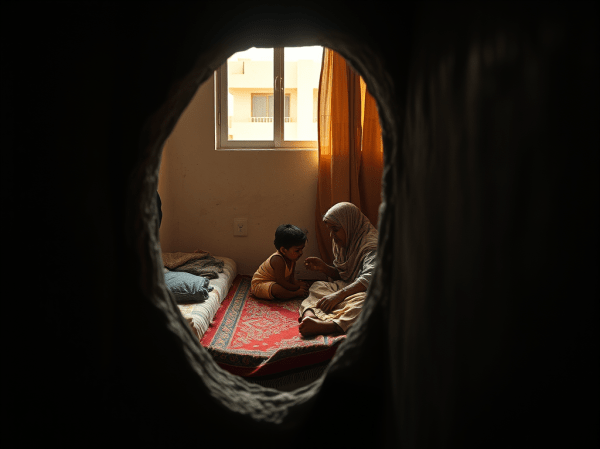
I stepped through a human-sized hole in the wall and found myself in a dim, humble space. There was one bed, a carpet for the children, and a small hose outside for bathing. Yet the first thing she did was serve me tea and bread. They had so little, but what they had, they shared.

That’s how I met Sana, their nine-year-old daughter. Instead of going to school, she worked—cleaning apartments like mine from top to bottom. The first time she cleaned our place, I paid her the equivalent of about $2.00US, and she was smiling from ear to ear. Then she pointed to the top of the fridge. I took down the bag of croissants and offered her one. She was in heaven!

We developed a sweet friendship. She loved me, and I loved her. After work, she would teach me Egyptian Arabic, and I would help her sound out verses of the Quran.

For a while, she became the daughter I never had.

On Eid day, I bought her family a whole basket of croissants and a jar of strawberry jam. She threw her arms around me and held me tightly. “Wallahi, (I swear to God) I love you Madame!” I had no children in my life then, and I was enjoying life; young and carefree, studying in Cairo. The pure love of a child felt so refreshing.

One day, after she finished work, I gave her half a cantelope from the fridge and a knife and let her sit on the balcony to eat it. Her brother came up looking for her, and I told him to go out there with his sister. Interestingly, the building owner’s daughter came to the door just then.

She came in, her eyes scanning the apartment. Her lips tightened as she glared at the children eating fruit on my balcony. Her disapproval was obvious—the help wasn’t supposed to be comfortable in my home. I had crossed a boundary. Yes, they were ‘the help’, I could not change that, but they were also children, deserving of compassion.

Despite the poverty of the Bawab family, somehow Sana’s dad managed to marry a second wife! It was incredible to me the drama that happened when that wife showed up at their hole-in-the- wall downstairs. If I didn’t have a front row seat, I would not have believed it. First, we were drawn to the balcony by the sound of women fiercely arguing…and then screaming.

As we rushed to the balcony to look over, there was Sana’s mom, running down the street with a small tree in her hand. She must have pulled it up from the sidewalk with her bare hands! She was holding it while chasing the second wife down the street. The second wife was screaming, ‘Help me someone, help!’.

We only witnessed the chase, but later on at tea next door, the building owner’s sister filled us in, “he has another wife!” she said in clear, careful English. Her sister and sister-in-law burst out laughing. I only understood bits and pieces of their Egyptian Arabic, but it had been decided that Sana’s family was too noisy and too troublesome.

Then, one day, they were gone. Just like that. The owner said they hadn’t “done a good job,” so the family was dismissed. My heart broke. I never got to say goodbye.

🌟 Lessons from a Hole in the Wall

That little room in Cairo taught me more about life than any lecture hall:

  • Privilege is fragile. Status can rise or fall depending on where we stand in the world. It is never the measure of our worth.
  • Hospitality is not about abundance. Tea, bread, and kindness can carry more warmth than the finest banquet.
  • Children remind us of what really matters. Love, laughter, and friendship do not need permission.
  • Compassion may look like rebellion. Loving across social lines will always make someone uncomfortable.
  • Even brief encounters can leave eternal imprints. Sana’s smile still lives in my memory, long after the door closed.

✨ Journal Prompts for Reflection

  1. Privilege & Compassion
    • Where in your own life do you experience privilege (social, financial, cultural)? How might God be inviting you to use it in service of others?
  2. Hospitality
    • Think of a time when someone with very little gave you something meaningful. What did it teach you about generosity and love?
  3. Boundaries & Compassion
    • Have you ever risked breaking social “rules” or expectations to show kindness? What happened, and what did you learn?
  4. Children as Teachers
    • What lessons have you learned from children that reminded you of God’s heart?

Healing for Muslim girls

💔 Through the Hijab: Healing Religious Trauma in the Lives of Muslim Girls

We speak endlessly about the struggles of Muslim women — their rights, their choices, their voices. But the stories of Muslim girls, ages 7 to 18, are often left untold. It’s as if they live behind a second veil — not of fabric, but of silence.

Growing up is hard enough. Growing up as a Muslim girl in an environment that demands strict conformity can feel like living under a microscope, every action weighed against the honor of the family, the image of the whole religion, and the fear of eternal punishment.

I’ve worked closely with Arab girls in the Middle East, Muslim teens in the West, and I’ve raised two Muslim daughters myself. I’ve seen firsthand how religious structures meant to guide can instead wound. I remember how my daughters struggled to follow the strict rules of hijab at the age of 7 and 8, negotiating long garments amid childhood play. The pressure to be “a good girl” often hides deep questions about love, identity, and autonomy — questions too dangerous to ask out loud.

🌍 Navigating Girlhood

Whether in the West or the Middle East, Muslim girls often struggle with identity issues that go beyond the typical teenage angst. They constantly weigh their decisions:

If I wear certain clothes, am I being immodest?
If I talk to a boy, am I disobeying my family or my faith?
If I’m found out, will I be punished — or will my family be ashamed?

These are not questions of simple rebellion. They are about survival. Fear of being labeled, of being found out, of bringing shame to one’s family — it all adds up to a kind of quiet trauma that can follow them into adulthood.

Recently, my daughter invited me to watch a teen soap opera, AlRawabi School for Girls — a Middle Eastern drama on Netflix set in Jordan. It hit close to home.

The show explores the secret lives of Arab girls at a private school — sneaking around for online romances, dealing with bullying, trying to navigate between traditional expectations and modern desires. One girl, Leanne, is under tight control from her brothers and father, but finds ways to rebel quietly. Watching this, I realized: this isn’t just drama. This is real life for many.

After Mariam is brutally bullied by Leanne and her friends, she plans revenge. However, her actions have unexpected consequences. The show reflects themes that are not commonly discussed: toxic patriarchy, bullying, mental health issues, religion and reputation, and the tradition of honor killings.

My two daughters spent half their childhood in the Middle East. They both know all too well what happens when girls are too controlled and suppressed. Though Leanne is presented as the villain of the story, she was just a girl, trying to prove her worthiness and curious about love.

The story, unfortunately, has a terrible ending for her.

🧩 Teenage Marriage and Complex Trauma

Here’s where it gets deeper — and darker. In the Salafi Islamic community, which I was once part of, the emphasis on marrying girls off early leads to a different kind of trauma.

I remember when I worked in the Islamic school, a mother pulled me aside to seek advice about her daughter, who had just turned 11.

“I see how she watches music videos and how she moves her body. She is acting like she’s ready to have sex.”

“Oh no, she’s much too young to really want to do it,” I reassured her. “She just needs more attention and more constructive activities.”

I told her about the Saudi girls I used to teach back in Madinah — how many came to the English institute just to get away from home. The virgins had a little freedom: malls, shopping with friends. But two of my young students had been divorcees; the grip on them was extremely tight.

“Because,” I explained to her, “after the girl has sex, she may desire it more afterwards… and if she ends up divorced, what will you do with an 11-year-old divorcee?”

My coworker sat back thoughtfully, then became resolute again.

“No, I have to protect her from fornication.”

I knew what that meant.

Only three months later, I had just had my baby, and I saw my coworker at a community event. After fussing over the baby, she introduced me to a veiled, smiling lady.

“This is Umm Muneeb. Her son has just proposed to my daughter.”

I tried not to look shocked as my heart pounded. They both smiled at each other with pride. I wanted to scream. I wanted to shake them both.

But my lips stayed shut as I heard the voice of “Elder Noble Brother” in my head:

“Let no one speak against the sunnah! It is a protection.”

Months later, Umm Muneeb was at my dining table. She stayed behind after Arabic class and told me the horrors her 15-year-old son faced when he discovered his wife was only 11. My coworker had lied and said she was 13. A divorce was arranged.

And it didn’t stop there.

After we moved back to the Middle East, we would make summer visits back to our community. I would see familiar faces at Eid gatherings in the park. Invited to barbeque burgers and blankets in the grass, I listened to more stories of teen marriages gone wrong. Boys and girls I had watched grow up had multiple divorces by age 17.

That broke my heart. It still saddens me.

💡 Healing is Possible — And You’re Not Alone

For every story like Leanne’s, and for every real-life girl whose voice has been silenced, there are countless others quietly enduring in the shadows. Some will never speak about the pressure, the shame, or the choices they never got to make. Others will find the courage to break free — and when they do, they need a safe place to land.

We can’t rewrite the past for these girls, but we can help write a different future. That begins with listening, believing their stories, and yes…even challenging harmful traditions — no matter how “normal” they have been made to seem.

To the Muslim girls who have been told they are too much, too curious, too emotional, too disobedient — know this: you are not too much. You are exactly enough. Your life, your voice, and your heart matter more than anyone’s reputation.

Healing from religious trauma isn’t a straight road, but it’s a journey worth taking. And the more we walk it together, the more light we can pour into the dark corners where silence has reigned for too long.

I, myself, was silent for too long.

If you see yourself in these words, or know someone who might, I invite you to join me for my upcoming workshop, Healing from Religious Trauma, here at Nela’s Nest. Because your story is worth telling — and your healing is worth fighting for. The link to the form is below.

https://forms.gle/UqceNJLYr7KrnsEz6

Healing Our Parenting: How Fixations Poison Relationships

What Is a Fixation?

I first learned this term through the work of the late Peter Gerlach, MSW. He spent 15 years creating a remarkable body of work on childhood trauma, family dynamics, and inner healing before his passing in 2015. I was blessed to speak with him in 2014 during a very difficult time in my life, and his insights stayed with me.

In Gerlach’s framework, a fixation happens when a parent becomes so focused on a specific standard, object, or outcome that it becomes more important than the relationship with their child.

How Fixations Look in Everyday Life

Fixations can be as simple as an obsession with a spotless kitchen.

  • One dirty dish in the sink becomes a fight.
  • Instead of connection, the parent leads with judgment, shame, or blame.

Or, take a father who excelled in sports — football, boxing, basketball — and sees his son as an extension of himself. His fixation is for the son to match his athletic achievements, even if the child’s own interests lie elsewhere. The picture in the parent’s mind takes priority over the real, living relationship.

The Sock Story: How Small Things Become Big Wounds

I once saw a little girl, around seven or eight, bubbling with excitement because she was going out with her dad. She got to the door, only for him to notice she had on one blue sock and one green sock.

Instead of brushing it off, he sent her back upstairs to change. The problem? She couldn’t find the matching socks — she had simply put on what she could.

By the time she came back down, her head was hung low in shame — that feeling that something is wrong with you, not just what you did. The joy of the moment was gone. The “sock incident” became a snapshot in her mind, imprinted with intense emotion, and those moments can leave chemical imprints in the body that affect long-term well-being.

Why This Matters for Healing Our Parenting

When fixations take center stage, children begin to associate being around us with tension instead of safety. Over time, this can create lasting damage:

  • They avoid being around us once they have the choice.
  • They carry nervousness or self-doubt into other relationships.
  • The bond is weakened by years of small, avoidable wounds.

We must ask ourselves:

  • Is my desire for cleanliness, order, appearance, or achievement stronger than my desire to connect with my child?
  • Am I willing to loosen my standard to protect the relationship?

A Better Way

My own father was meticulous — the kind who aligned vacuum lines on the carpet. But he never let his perfectionism poison his relationships. If he saw a dish in the sink, he’d wash it himself, sometimes with a light comment, but always prioritizing connection over criticism.

That’s leadership. That’s love.

The Takeaway

Fixations may seem small in the moment, but they can poison the parent-child bond for years. As parents, we are called to put relationship above rigid standards. The immaculate kitchen, matching socks, or perfect picture in our minds is not worth losing the trust and warmth of our children.

When we choose connection over control, we plant seeds for lifelong closeness — and we break the cycle of shame and perfectionism that can pass down through generations.


Key Lessons:

  1. Fixations are relationship killers — they put objects or standards above people.
  2. Small incidents can leave lasting scars when handled with criticism instead of compassion.
  3. Connection must outweigh control if we want a strong lifelong bond with our children.
  4. Healing starts with self-awareness — notice when your standard is more about your own comfort or ego than your child’s well-being.

Reflection Prompt: Take a moment today to notice if your standards, habits, or personal fixations are coming before connection with your child. Ask yourself: What would love choose in this moment?

Every small step you take toward healing yourself is a step toward breaking generational cycles and building a legacy of trust and safety.

Healing Our Parenting isn’t about being perfect — it’s about being present, honest, and willing to grow alongside our children.

Until the next post,

Peace, Shalom and Salam,

Nela

The Healing Effects of Yoga: Breath, Body & Balance

Nela’s Nest | August 1, 2025

Yesterday evening, I found myself at an outdoor yoga class. The sun hadn’t set yet, and it was still hot—a steady 90 degrees at 6 p.m. I arrived early, secured a perfect spot, and stretched out my mat in the thick summer heat.

As the class began, I glanced behind me and was amazed by how many people had quietly joined. Something about the open sky, the golden light, and the communal breath made it feel sacred.

And the best part? The class was just right. Not too hard, not too easy—just enough to challenge me without overwhelm. I felt strong, stable, and present.

My Body Keeps the Score—and Rewards Me

One of the things I’ve noticed about yoga is how faithfully the body responds to consistency. I’ve only been practicing once, now twice a week, since the school year ended, and still—each time I go, my body rewards me. A little more balance. A little deeper stretch. A little longer hold.

There’s this one pose—standing pigeon—where you balance on one leg, cross the other over your thigh, and squat. It used to wobble me into frustration. But now? I’m stunned at how long I can hold it.

Same with warrior three, where you balance on one leg and extend the other behind you while reaching forward. I held it outside for the first time and thought, Who is this girl?

Maybe it was the fresh air. Maybe it was the heat softening my muscles. Or maybe…it was just the payoff of slow, steady healing. There is a Belgian scientist who talks about the way yoga helps release trauma from the body. The more fluid I feel, the more I believe him.

The Long Game of Embodied Recovery

Yoga isn’t a quick fix. It’s a long game. Over the past school year, I practiced once a week. That was it. But even that modest consistency reshaped me—literally and figuratively.

The fluidity in my body is real. I haven’t needed to see a chiropractor in months. My spine just… realigns itself. A good stretch, a deep breath—and crack, crack, crack. Instant release.

I’ve also added Pilates to the mix. The combination of posture work, core strength, balance, and intentional movement has been amazing. For anyone healing from trauma or emotional stress, these kinds of movement practices are powerful. They speak the language of the body—something most of us were never taught to understand.

Movement as Medicine

I’ve come to realize: healing isn’t just about talking or praying—it’s also about moving.

In fact, for me, movement came naturally after breath and after words. First I learned how to speak what I was feeling. Then I learned how to breathe through it. And eventually, I started to move my body through it. Even before I ever heard the term somatic healing, I was living it.

The body knows how to recover. You just have to give it the space, the tools, and the rhythm to do so.

Yoga and Pilates have given me a new set point—a new default. My nervous system isn’t holding the same tension it used to. I’m more flexible, more aware, more grounded in my own skin.

Healing Is a Whole-Body Experience

Whether it’s releasing the pain of religious trauma, navigating motherhood, or simply trying to reconnect to joy—healing is a whole-body experience. It happens through breath, through movement, through stillness, and through sweat.

That yoga class reminded me: I don’t have to strive. I just have to show up.

And every time I do, my body says thank you.

☕ Love what you read? Want to say thank you?
Treat me to a hot yoga session 🧘🏾‍♀️💦
👉 Send via Venmo @Nelasnest or via CashApp @Nela’s Nest 2025 ($nelasnest)

Your support helps fuel my healing—and lets me stretch a little deeper. 💛

Peace, Shalom, Salaam

Nela

Blog at WordPress.com.

Up ↑