Nela’s Nest | August 1, 2025
Yesterday evening, I found myself at an outdoor yoga class. The sun hadn’t set yet, and it was still hot—a steady 90 degrees at 6 p.m. I arrived early, secured a perfect spot, and stretched out my mat in the thick summer heat.
As the class began, I glanced behind me and was amazed by how many people had quietly joined. Something about the open sky, the golden light, and the communal breath made it feel sacred.
And the best part? The class was just right. Not too hard, not too easy—just enough to challenge me without overwhelm. I felt strong, stable, and present.
My Body Keeps the Score—and Rewards Me
One of the things I’ve noticed about yoga is how faithfully the body responds to consistency. I’ve only been practicing once, now twice a week, since the school year ended, and still—each time I go, my body rewards me. A little more balance. A little deeper stretch. A little longer hold.
There’s this one pose—standing pigeon—where you balance on one leg, cross the other over your thigh, and squat. It used to wobble me into frustration. But now? I’m stunned at how long I can hold it.

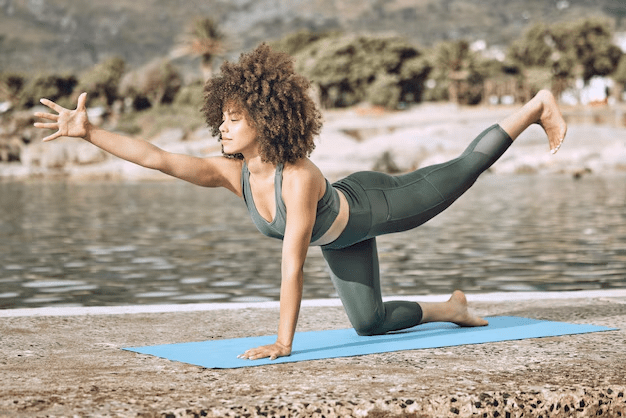
Same with warrior three, where you balance on one leg and extend the other behind you while reaching forward. I held it outside for the first time and thought, Who is this girl?
Maybe it was the fresh air. Maybe it was the heat softening my muscles. Or maybe…it was just the payoff of slow, steady healing. There is a Belgian scientist who talks about the way yoga helps release trauma from the body. The more fluid I feel, the more I believe him.
The Long Game of Embodied Recovery
Yoga isn’t a quick fix. It’s a long game. Over the past school year, I practiced once a week. That was it. But even that modest consistency reshaped me—literally and figuratively.
The fluidity in my body is real. I haven’t needed to see a chiropractor in months. My spine just… realigns itself. A good stretch, a deep breath—and crack, crack, crack. Instant release.
I’ve also added Pilates to the mix. The combination of posture work, core strength, balance, and intentional movement has been amazing. For anyone healing from trauma or emotional stress, these kinds of movement practices are powerful. They speak the language of the body—something most of us were never taught to understand.
Movement as Medicine
I’ve come to realize: healing isn’t just about talking or praying—it’s also about moving.
In fact, for me, movement came naturally after breath and after words. First I learned how to speak what I was feeling. Then I learned how to breathe through it. And eventually, I started to move my body through it. Even before I ever heard the term somatic healing, I was living it.
The body knows how to recover. You just have to give it the space, the tools, and the rhythm to do so.
Yoga and Pilates have given me a new set point—a new default. My nervous system isn’t holding the same tension it used to. I’m more flexible, more aware, more grounded in my own skin.
Healing Is a Whole-Body Experience
Whether it’s releasing the pain of religious trauma, navigating motherhood, or simply trying to reconnect to joy—healing is a whole-body experience. It happens through breath, through movement, through stillness, and through sweat.
That yoga class reminded me: I don’t have to strive. I just have to show up.
And every time I do, my body says thank you.
☕ Love what you read? Want to say thank you?
Treat me to a hot yoga session 🧘🏾♀️💦
👉 Send via Venmo @Nelasnest or via CashApp @Nela’s Nest 2025 ($nelasnest)
Your support helps fuel my healing—and lets me stretch a little deeper. 💛
Peace, Shalom, Salaam
Nela
 Nela's Nest
Leave a comment