✨ When Belief Becomes a Battle: Healing from Religious Trauma

By Nela Jaye

Last night, I had the kind of conversation that stays with you. I met a woman from the Middle East—she spoke fluent Arabic, and we instantly connected at a Bible study. There’s something powerful about meeting someone who understands the layers of your story, even if you’ve only just met. As we talked, switching between English and Arabic, I saw her eyes widen at my testimony. She showed me her arms, “I have goosebumps,” she said in amazement. She wasn’t expecting it. But then again, neither was I—because even in sharing my story, I often forget just how far I’ve come.

Today, that conversation took me back—to Egypt, to Milwaukee, to street corners, train stations, and unexpected living rooms where my past collided with glimpses of another truth I wasn’t ready to receive.

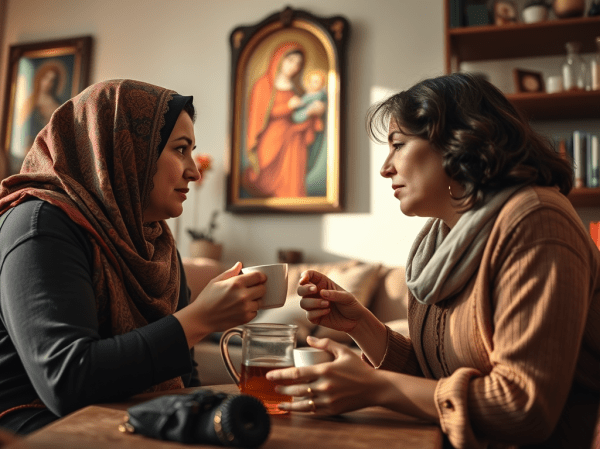
Tea with Mary and Jesus in Cairo

In 1997, while living in Cairo, I had one of my first real encounters with an Egyptian Christian. Dressed like everyone else—long skirt, scarf, modest top—she didn’t stand out in any religious way. Muslims and Christians dressed the same, lived side by side, and yet bore unspoken tensions from past conflicts. ,,,

We were lost, looking for an address, and she guided us through twisting backstreets like she’d known us forever. That’s how we ended up in her living room, drinking tea. That’s how I saw the portrait of Mary and baby Jesus on her wall. That was her quiet way of telling me who she was. She didn’t say it out loud at first—there was hesitation, caution. But when I told her I was from America, she relaxed. We smiled, and in that moment, it didn’t matter that we believed different things.nn

What I remember most wasn’t the theology or the doctrine—it was the tea, the warmth, the way her home opened to us like an offering.

The Milwaukee Encounter That Exposed My Hard Heart

A few years later, in 1999, I was standing outside a mall in Milwaukee, covered in black from head to toe. I was a practicing Sunni Muslim, living by strict codes of modesty, gender interaction, and belief. A Christian couple approached me—handing out tracts, smiling.

The woman spoke first. “Do you know about Jesus?”

What came next was a storm. I hit her with ayah after ayah, verse after verse from the Quran—about Isa (Jesus), about salvation, about hell. My tone wasn’t calm or curious—it was combative, righteous, cutting. She stepped back. I saw her fear. And then her husband spoke. I looked him in the face for the first time and froze. He was Arab.

“Where are you from?” I asked.

“Egypt,” he said. “I used to be Muslim too.”

And I lost it. I let him have it with full force—reciting Quran, rejecting everything he stood for. But he didn’t flinch. Instead, he gently quoted a verse I had always known but never truly heard:

“If you are in doubt about what We have revealed, ask those who have been reading the Book before you.”
—Surah Yunus (10:94)

He asked, “Why would your Quran tell you to ask us—the Christians—if you doubt?”

I couldn’t take it in. My entire identity was wrapped up in defending Islam. My heart wasn’t open. My ears weren’t listening. I threw more verses, more doctrine. Finally, he turned to his wife and said, “You see how the Muslims are? That’s why I left.”

They walked away. I was left standing there—angry, victorious, but somehow empty.

When You Realize You Were the Pharisee

Years later, reading the Gospel of John, I came face to face with myself. The religious leaders Jesus confronted—those who knew the law, who followed every rule, but missed the heart of God—I saw myself in them.

“You study the Scriptures diligently because you think that in them you have eternal life. These are the very Scriptures that testify about me, yet you refuse to come to me to have life.”
—John 5:39-40

My speech, my arguments, my pride—they weren’t fruit of the Spirit. They were the product of fear and indoctrination. I was so sure I was defending truth, but in reality, I was protecting a version of myself that couldn’t afford to be wrong.

Healing the Hardness

Religious trauma isn’t always about abuse or manipulation. Sometimes, it’s about how deeply we internalize dogma—how we build our identity around being right and lose the softness of spirit that allows for grace, curiosity, and love.

It took years to heal the parts of me that had calcified under the weight of religious certainty. But healing started with honesty—with revisiting stories like these and seeing them through new eyes.

Reflection + Journaling Prompt

“Above all else, guard your heart, for everything you do flows from it.”
—Proverbs 4:23

Prompt:
Have you ever found yourself more focused on being “right” than being loving? What moments from your past reveal a hard heart—and what would healing look like for that part of you?

I do not tell these stories simply for entertainment. I share because I am certain that others have struggled with the same experience. I am holding a torchlight for you at the end of the tunnel.

Nela

nelajaye@gmail.com

Good morning Message,

Time to pull out your journal…

Good morning.

This is Nela. I’m so glad you decided to join me on Nela’s Nest dot blog. I want to ask you a question. If you’re here and you’re searching, if you’re searching for answers, if you’re searching for peace, if you’re searching for clarity after confusion. (0:33) When I see this question, are you carrying guilt and shame? You know, I spoke with a woman from a global organization. She works with ex-Muslims from all around the world, from Iran, Iraq, Afghanistan, Saudi Arabia, Egypt.   I myself have listened to ex-Muslim stories from, you know, U.S. other places. And there’s one thing that keeps coming up in these conversations. And that is guilt and shame. (1:16) Guilt says that I have done something wrong. Shame says that I am something wrong. Both of these are very toxic to our spiritual and emotional health. Now, what happens to a lot of Muslims while they may have good intentions in trying their best to practice the religion of Islam? (1:45) They find that they don’t meet the mark. And not meeting the mark might be, you know, missing prayers or missing fast, for example, or not wearing hijab or maybe falling into something that is considered forbidden.(2:09) Whatever the case may be, what happens, the cycle of the guilt and shame is that the person feels guilty for not doing or for doing wrong. (2:24) That’s number one. Then number two, they have to conceal it.They can’t share it with their friend that, you know what? I don’t want to fast Ramadan tomorrow. I don’t feel like fasting. (2:38) Or can I just fast, you know, a week out of Ramadan or do I have to do the whole 30 days? Or, you know what, I never made up my fast.  I’m so bad. I’m such a bad Muslim, such a bad person. There’s something wrong with me. So I can easily go from guilt straight to shame by first convicting myself for not doing. (3:05) And then proclaiming that inside of myself, and all this is going on inside of my own heart and my own mind, proclaiming that there’s something wrong with me. (3:17) And that’s the shame.And then the longer I keep it secret and try to cover it up, like a lot of Muslim youth are doing, the deeper the guilt and the shame becomes. (3:38) And now the tragedy of that is that my perception of what God thinks of me is all distorted. There are Muslims who think that God doesn’t love them.(3:58) God has cursed them. God is punishing them. They don’t know if God forgives them.And this is very, very trying on a human soul. (4:15) And so this space here is meant to be a space of healing. And so in a space of healing, there are certain things that have to be rooted out, certain things that cannot be present.(4:32) One of them is guilt. Another one is shame. Another one is blame.. So how do you feel about your relationship with God? (4:48) Do you feel that you are valuable to him? Do you feel that he loves you? Do you feel that you are loved? Do you feel that you are supported? (4:56) Do you believe that you’re worthy of God’s love? What are your thoughts, feelings around your relationship with God? (5:11) So I want to challenge you this morning. If you’re willing, if you are willing to journal and write down, really what’s in your mind, really what’s in your heart. (5:27) Because I can almost guarantee you, someone else feels the same way. Sometimes we feel like we’re alone. Like I’m the only one who feels like this. (5:39) I’m the only one who’s struggling with this. But that’s a trick of the enemy to keep you isolated. And the more isolated you feel, the longer it might take for you to heal. (6:00) So this was just a short message this morning.I hope this will benefit you. And pretty soon I will hold a very confidential private Zoom meeting for us to get together. (6:16) And discuss these things.

Take care. Peace.

Nela

I Have Heard Your Reactions

Dear Friends,

Good evening. This is Nela.

I want to acknowledge that my recent interview has been both shocking and deeply painful for many Muslims who knew me. I’ve heard your feedback, and I want you to know that I receive it with humility.

What I shared came from a place of deep personal struggle—a crisis of faith that was agonizing and transformative. It’s an excruciating grief I would not wish on anyone. The joy I expressed was not aimed at mocking Muslims, but at celebrating the freedom I’ve found after years of spiritual confusion. Only a few months ago, I could not have spoken about these things without bitter tears.

I wish I could have spared you the hurt of hearing the news. But you should know that my faith transition has happened over the course of 3 years. and no one is more shocked about it than me. I did not ask for this or plan it. I’m still fascinated and astonished at this whole spiritual journey myself.

Though I consistently participate in healing work, I will own that there are areas of my spirit where I am still releasing anger and disillusionment. There may be moments when these residual emotions leak out, masked by sarcasm.

And I take full accountability for what I say and how I say it.

I understand that Muslims are listening, and intend to be mindful of how I speak moving forward.

This is my story—my truth. My goal is never to cause harm, but to bear witness to the journey God is guiding me through.

My platform, Nela’s Nest, is a space carefully created for women of all faiths. This is not meant to be a forum for argument or hostile debate though thoughtful and healthy discourse is welcome. Our ultimate mission is clear: to assist women in the deep and sacred work of healing and recovery from emotional and spiritual trauma.

The topic; Perspectives on Islam is only a pretense for my platform — the gateway into my own journey of healing. It was through this deeply personal process of examining Islam, allowing myself to ask questions and face my doubts, that my eyes were opened.

I will share what God has revealed to me through His Living Word — about Islam and the Abrahamic faiths more broadly. Once all questions, doubts, and insights have found their voice — we will move into a powerful spiritual transition: rebuking falsehood and replacing it with truth.

After this foundational work is complete, we can then fully engage with the heart of this platform:
Healing and Recovery from Trauma — A Wise Woman’s Toolbox.

Thank you to everyone who has reached out, challenged me, or simply listened.

With respect and sincerity,
Nela

formerly known as ‘Nadiya’

Blog at WordPress.com.

Up ↑