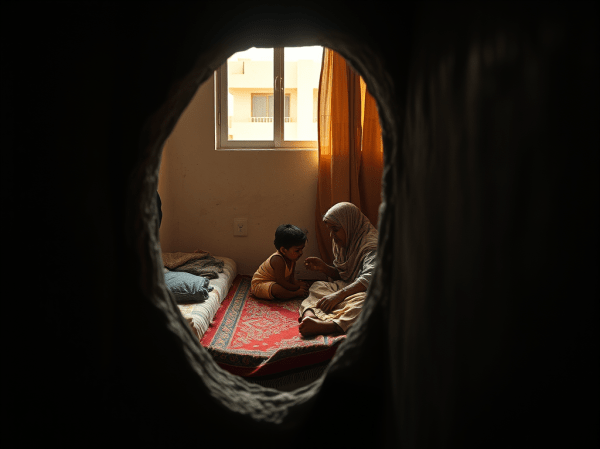
🌍 Cairo, Egypt, 1996
(Book Excerpt from Veiled & Redeemed)
Sometimes the most profound lessons about humanity don’t come from palaces, mosques, or cathedrals. Sometimes they come from a hole in the wall.
When I moved to Cairo, I quickly learned how my U.S. passport changed the way people saw me. Back home I came from a working-class family, but in Egypt, I was suddenly treated like someone of status. I sat on Louis XVI furniture, was served by others, and felt the strange glow of privilege. At first, it felt good—until I saw who was serving me.
In Egypt they are called bawabs—literally, “door people.” They lived in holes or empty spaces in the sides or bottom floors of apartment buildings. They were small, unfinished spaces yet entire families lived in them. They carried groceries, opened doors, cleaned apartments, and ran errands for tips that amounted to a few U.S. dollars. I could stand on the balcony and call down ‘Yaa Ahmad!” and he or someone from the family would come running. That was their world, while I lived upstairs in another.
One day, my curiosity got the best of me. I had lost my door key, and Mimi, my mother-in-law, was out shopping when I arrived home from Arabic school. It was springtime in Egypt and the temperature was moderate. I sat outside and people-watched as I normally did from our 3rd-floor balcony.
As I sat outside, the bawab’s wife greeted me warmly: “Salam, Madame! Amala eyh?” (“Peace to you, Madame! How are you?”).
I said, ‘I forgot my key,” in my perfect classical Arabic, “and Mama is not home.” I tried to mix in a little Egyptian colloquial, ‘Mama mish gowa‘. I said.
She shook her head and smiled. Then she did the unthinkable…she motioned her hand to invite me inside, “tafadalee, Madame!” (Come in!) She invited me around the corner into her home.
I stepped through a human-sized hole in the wall and found myself in a dim, humble space. There was one bed, a carpet for the children, and a small hose outside for bathing. Yet the first thing she did was serve me tea and bread. They had so little, but what they had, they shared.
That’s how I met Sana, their nine-year-old daughter. Instead of going to school, she worked—cleaning apartments like mine from top to bottom. The first time she cleaned our place, I paid her the equivalent of about $2.00US, and she was smiling from ear to ear. Then she pointed to the top of the fridge. I took down the bag of croissants and offered her one. She was in heaven!
We developed a sweet friendship. She loved me, and I loved her. After work, she would teach me Egyptian Arabic, and I would help her sound out verses of the Quran.
For a while, she became the daughter I never had.
On Eid day, I bought her family a whole basket of croissants and a jar of strawberry jam. She threw her arms around me and held me tightly. “Wallahi, (I swear to God) I love you Madame!” I had no children in my life then, and I was enjoying life; young and carefree, studying in Cairo. The pure love of a child felt so refreshing.
One day, after she finished work, I gave her half a cantelope from the fridge and a knife and let her sit on the balcony to eat it. Her brother came up looking for her, and I told him to go out there with his sister. Interestingly, the building owner’s daughter came to the door just then.
She came in, her eyes scanning the apartment. Her lips tightened as she glared at the children eating fruit on my balcony. Her disapproval was obvious—the help wasn’t supposed to be comfortable in my home. I had crossed a boundary. Yes, they were ‘the help’, I could not change that, but they were also children, deserving of compassion.
Despite the poverty of the Bawab family, somehow Sana’s dad managed to marry a second wife! It was incredible to me the drama that happened when that wife showed up at their hole-in-the- wall downstairs. If I didn’t have a front row seat, I would not have believed it. First, we were drawn to the balcony by the sound of women fiercely arguing…and then screaming.
As we rushed to the balcony to look over, there was Sana’s mom, running down the street with a small tree in her hand. She must have pulled it up from the sidewalk with her bare hands! She was holding it while chasing the second wife down the street. The second wife was screaming, ‘Help me someone, help!’.
We only witnessed the chase, but later on at tea next door, the building owner’s sister filled us in, “he has another wife!” she said in clear, careful English. Her sister and sister-in-law burst out laughing. I only understood bits and pieces of their Egyptian Arabic, but it had been decided that Sana’s family was too noisy and too troublesome.
Then, one day, they were gone. Just like that. The owner said they hadn’t “done a good job,” so the family was dismissed. My heart broke. I never got to say goodbye.
🌟 Lessons from a Hole in the Wall
That little room in Cairo taught me more about life than any lecture hall:
- Privilege is fragile. Status can rise or fall depending on where we stand in the world. It is never the measure of our worth.
- Hospitality is not about abundance. Tea, bread, and kindness can carry more warmth than the finest banquet.
- Children remind us of what really matters. Love, laughter, and friendship do not need permission.
- Compassion may look like rebellion. Loving across social lines will always make someone uncomfortable.
- Even brief encounters can leave eternal imprints. Sana’s smile still lives in my memory, long after the door closed.
✨ Journal Prompts for Reflection
- Privilege & Compassion
- Where in your own life do you experience privilege (social, financial, cultural)? How might God be inviting you to use it in service of others?
- Hospitality
- Think of a time when someone with very little gave you something meaningful. What did it teach you about generosity and love?
- Boundaries & Compassion
- Have you ever risked breaking social “rules” or expectations to show kindness? What happened, and what did you learn?
- Children as Teachers
- What lessons have you learned from children that reminded you of God’s heart?

 Nela's Nest