A Sanctuary for Trauma Healing, Not a Spotlight on Me
What brought me here is not why I am here.
Yes, it was trauma—religious trauma, emotional trauma, and the collapse of everything I thought was true—that pushed me into the healing process. My story includes an emotional breakdown in 2018, a faith crisis the following year, and the slow, agonizing unraveling of a belief system I had committed to for more than 25 years. Those experiences shook me awake. They forced me to confront the gap between what I believed and what I truly knew in my soul.
But make no mistake: that is not why Nela’s Nest exists.
My personal story is simply the doorway. It is not the destination.
I share pieces of my journey—my years in the Middle East, my deconstruction process, the grief I carried, and the truths I uncovered—not to center myself, but to create connection. I offer my experience as a bridge so others don’t feel alone as they walk their own difficult path toward healing.
Because the real mission of Nela’s Nest is this:
🌿 To support the healing and recovery of those who carry childhood trauma, spiritual trauma, or both.
What I learned on my own journey is something I never expected: The religious and spiritual wounds I suffered did not begin with religion. They were rooted in my childhood.
Unmet needs. Silent pain. Confusion that had no language. A longing to belong. Fear of disappointing people who held power over me.
These early wounds laid the foundation for later spiritual trauma. They created vulnerabilities—openings—through which harmful teachings, rigid systems, and fear-based doctrines took hold.
When I finally began untangling my religious trauma, I found the deeper root beneath it. And that changed everything.
🌱 Healing, I discovered, is an inside-out process.
You cannot heal religious trauma without addressing the childhood patterns that allowed it to shape you. You cannot reclaim your spiritual life without understanding the emotional life that lived beneath it. You cannot build a new identity without honoring the parts of you that were silenced, ignored, or conditioned to accept harm.
Nela’s Nest was created to support you through this entire journey.
This is a space for:
asking questions without fear
understanding the connection between childhood wounds and spiritual patterns
learning how trauma shapes the way we believe, trust, love, and relate
rebuilding a sense of self rooted in truth, not fear
finding compassion for the parts of you that had to survive
I am here not as a guru, not as a religious authority, and not as the center of the story— but as a fellow traveler who learned how to climb out of a deep, dark place and now extends a hand to help others find their way too.
Welcome to the Nest. This is your sanctuary. This is your soft place to land. This is where healing begins.
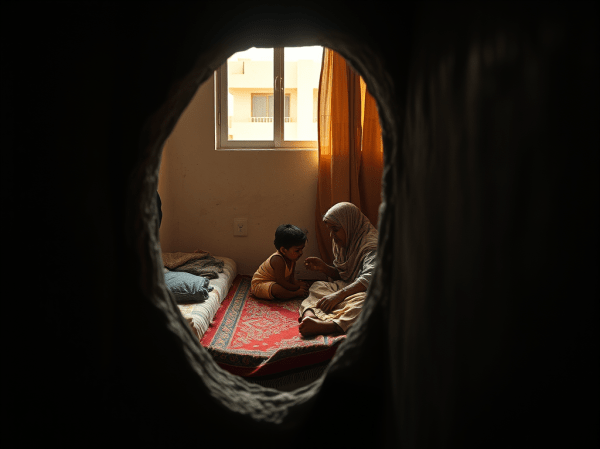
Sometimes the most profound lessons about humanity don’t come from palaces, mosques, or cathedrals. Sometimes they come from a hole in the wall.
When I moved to Cairo, I quickly learned how my U.S. passport changed the way people saw me. Back home I came from a working-class family, but in Egypt, I was suddenly treated like someone of status. I sat on Louis XVI furniture, was served by others, and felt the strange glow of privilege. At first, it felt good—until I saw who was serving me.
In Egypt they are called bawabs—literally, “door people.” They lived in holes or empty spaces in the sides or bottom floors of apartment buildings. They were small, unfinished spaces yet entire families lived in them. They carried groceries, opened doors, cleaned apartments, and ran errands for tips that amounted to a few U.S. dollars. I could stand on the balcony and call down ‘Yaa Ahmad!” and he or someone from the family would come running. That was their world, while I lived upstairs in another.
One day, my curiosity got the best of me. I had lost my door key, and Mimi, my mother-in-law, was out shopping when I arrived home from Arabic school. It was springtime in Egypt and the temperature was moderate. I sat outside and people-watched as I normally did from our 3rd-floor balcony.
As I sat outside, the bawab’s wife greeted me warmly: “Salam, Madame! Amala eyh?” (“Peace to you, Madame! How are you?”).
I said, ‘I forgot my key,” in my perfect classical Arabic, “and Mama is not home.” I tried to mix in a little Egyptian colloquial, ‘Mama mish gowa‘. I said.
She shook her head and smiled. Then she did the unthinkable…she motioned her hand to invite me inside, “tafadalee, Madame!” (Come in!) She invited me around the corner into her home.
I stepped through a human-sized hole in the wall and found myself in a dim, humble space. There was one bed, a carpet for the children, and a small hose outside for bathing. Yet the first thing she did was serve me tea and bread. They had so little, but what they had, they shared.
That’s how I met Sana, their nine-year-old daughter. Instead of going to school, she worked—cleaning apartments like mine from top to bottom. The first time she cleaned our place, I paid her the equivalent of about $2.00US, and she was smiling from ear to ear. Then she pointed to the top of the fridge. I took down the bag of croissants and offered her one. She was in heaven!
We developed a sweet friendship. She loved me, and I loved her. After work, she would teach me Egyptian Arabic, and I would help her sound out verses of the Quran.
For a while, she became the daughter I never had.
On Eid day, I bought her family a whole basket of croissants and a jar of strawberry jam. She threw her arms around me and held me tightly. “Wallahi, (I swear to God) I love you Madame!” I had no children in my life then, and I was enjoying life; young and carefree, studying in Cairo. The pure love of a child felt so refreshing.
One day, after she finished work, I gave her half a cantelope from the fridge and a knife and let her sit on the balcony to eat it. Her brother came up looking for her, and I told him to go out there with his sister. Interestingly, the building owner’s daughter came to the door just then.
She came in, her eyes scanning the apartment. Her lips tightened as she glared at the children eating fruit on my balcony. Her disapproval was obvious—the help wasn’t supposed to be comfortable in my home. I had crossed a boundary. Yes, they were ‘the help’, I could not change that, but they were also children, deserving of compassion.
Despite the poverty of the Bawab family, somehow Sana’s dad managed to marry a second wife! It was incredible to me the drama that happened when that wife showed up at their hole-in-the- wall downstairs. If I didn’t have a front row seat, I would not have believed it. First, we were drawn to the balcony by the sound of women fiercely arguing…and then screaming.
As we rushed to the balcony to look over, there was Sana’s mom, running down the street with a small tree in her hand. She must have pulled it up from the sidewalk with her bare hands! She was holding it while chasing the second wife down the street. The second wife was screaming, ‘Help me someone, help!’.
We only witnessed the chase, but later on at tea next door, the building owner’s sister filled us in, “he has another wife!” she said in clear, careful English. Her sister and sister-in-law burst out laughing. I only understood bits and pieces of their Egyptian Arabic, but it had been decided that Sana’s family was too noisy and too troublesome.
Then, one day, they were gone. Just like that. The owner said they hadn’t “done a good job,” so the family was dismissed. My heart broke. I never got to say goodbye.
🌟 Lessons from a Hole in the Wall
That little room in Cairo taught me more about life than any lecture hall:
Privilege is fragile. Status can rise or fall depending on where we stand in the world. It is never the measure of our worth.
Hospitality is not about abundance. Tea, bread, and kindness can carry more warmth than the finest banquet.
Children remind us of what really matters. Love, laughter, and friendship do not need permission.
Compassion may look like rebellion. Loving across social lines will always make someone uncomfortable.
Even brief encounters can leave eternal imprints. Sana’s smile still lives in my memory, long after the door closed.
✨ Journal Prompts for Reflection
Privilege & Compassion
Where in your own life do you experience privilege (social, financial, cultural)? How might God be inviting you to use it in service of others?
Hospitality
Think of a time when someone with very little gave you something meaningful. What did it teach you about generosity and love?
Boundaries & Compassion
Have you ever risked breaking social “rules” or expectations to show kindness? What happened, and what did you learn?
Children as Teachers
What lessons have you learned from children that reminded you of God’s heart?
💔 Through the Hijab: Healing Religious Trauma in the Lives of Muslim Girls
We speak endlessly about the struggles of Muslim women — their rights, their choices, their voices. But the stories of Muslim girls, ages 7 to 18, are often left untold. It’s as if they live behind a second veil — not of fabric, but of silence.
Growing up is hard enough. Growing up as a Muslim girl in an environment that demands strict conformity can feel like living under a microscope, every action weighed against the honor of the family, the image of the whole religion, and the fear of eternal punishment.
I’ve worked closely with Arab girls in the Middle East, Muslim teens in the West, and I’ve raised two Muslim daughters myself. I’ve seen firsthand how religious structures meant to guide can instead wound. I remember how my daughters struggled to follow the strict rules of hijab at the age of 7 and 8, negotiating long garments amid childhood play. The pressure to be “a good girl” often hides deep questions about love, identity, and autonomy — questions too dangerous to ask out loud.
🌍 Navigating Girlhood
Whether in the West or the Middle East, Muslim girls often struggle with identity issues that go beyond the typical teenage angst. They constantly weigh their decisions:
If I wear certain clothes, am I being immodest? If I talk to a boy, am I disobeying my family or my faith? If I’m found out, will I be punished — or will my family be ashamed?
These are not questions of simple rebellion. They are about survival. Fear of being labeled, of being found out, of bringing shame to one’s family — it all adds up to a kind of quiet trauma that can follow them into adulthood.
Recently, my daughter invited me to watch a teen soap opera, AlRawabi School for Girls — a Middle Eastern drama on Netflix set in Jordan. It hit close to home.
The show explores the secret lives of Arab girls at a private school — sneaking around for online romances, dealing with bullying, trying to navigate between traditional expectations and modern desires. One girl, Leanne, is under tight control from her brothers and father, but finds ways to rebel quietly. Watching this, I realized: this isn’t just drama. This is real life for many.
After Mariam is brutally bullied by Leanne and her friends, she plans revenge. However, her actions have unexpected consequences. The show reflects themes that are not commonly discussed: toxic patriarchy, bullying, mental health issues, religion and reputation, and the tradition of honor killings.
My two daughters spent half their childhood in the Middle East. They both know all too well what happens when girls are too controlled and suppressed. Though Leanne is presented as the villain of the story, she was just a girl, trying to prove her worthiness and curious about love.
The story, unfortunately, has a terrible ending for her.
🧩 Teenage Marriage and Complex Trauma
Here’s where it gets deeper — and darker. In the Salafi Islamic community, which I was once part of, the emphasis on marrying girls off early leads to a different kind of trauma.
I remember when I worked in the Islamic school, a mother pulled me aside to seek advice about her daughter, who had just turned 11.
“I see how she watches music videos and how she moves her body. She is acting like she’s ready to have sex.”
“Oh no, she’s much too young to really want to do it,” I reassured her. “She just needs more attention and more constructive activities.”
I told her about the Saudi girls I used to teach back in Madinah — how many came to the English institute just to get away from home. The virgins had a little freedom: malls, shopping with friends. But two of my young students had been divorcees; the grip on them was extremely tight.
“Because,” I explained to her, “after the girl has sex, she may desire it more afterwards… and if she ends up divorced, what will you do with an 11-year-old divorcee?”
My coworker sat back thoughtfully, then became resolute again.
“No, I have to protect her from fornication.”
I knew what that meant.
Only three months later, I had just had my baby, and I saw my coworker at a community event. After fussing over the baby, she introduced me to a veiled, smiling lady.
“This is Umm Muneeb. Her son has just proposed to my daughter.”
I tried not to look shocked as my heart pounded. They both smiled at each other with pride. I wanted to scream. I wanted to shake them both.
But my lips stayed shut as I heard the voice of “Elder Noble Brother” in my head:
“Let no one speak against the sunnah! It is a protection.”
Months later, Umm Muneeb was at my dining table. She stayed behind after Arabic class and told me the horrors her 15-year-old son faced when he discovered his wife was only 11. My coworker had lied and said she was 13. A divorce was arranged.
And it didn’t stop there.
After we moved back to the Middle East, we would make summer visits back to our community. I would see familiar faces at Eid gatherings in the park. Invited to barbeque burgers and blankets in the grass, I listened to more stories of teen marriages gone wrong. Boys and girls I had watched grow up had multiple divorces by age 17.
That broke my heart. It still saddens me.
💡 Healing is Possible — And You’re Not Alone
For every story like Leanne’s, and for every real-life girl whose voice has been silenced, there are countless others quietly enduring in the shadows. Some will never speak about the pressure, the shame, or the choices they never got to make. Others will find the courage to break free — and when they do, they need a safe place to land.
We can’t rewrite the past for these girls, but we can help write a different future. That begins with listening, believing their stories, and yes…even challenging harmful traditions — no matter how “normal” they have been made to seem.
To the Muslim girls who have been told they are too much, too curious, too emotional, too disobedient — know this: you are not too much. You are exactly enough. Your life, your voice, and your heart matter more than anyone’s reputation.
Healing from religious trauma isn’t a straight road, but it’s a journey worth taking. And the more we walk it together, the more light we can pour into the dark corners where silence has reigned for too long.
I, myself, was silent for too long.
If you see yourself in these words, or know someone who might, I invite you to join me for my upcoming workshop, Healing from Religious Trauma, here at Nela’s Nest. Because your story is worth telling — and your healing is worth fighting for. The link to the form is below.
What does that mean? It means intentionally re-entering spaces or dynamics that once hurt me—but this time, with new tools, insight, and boundaries. The goal is to rewire the way my body and mind respond. I don’t just relive the experience—I redo it with wisdom and strength.
For me, a big part of that correctional work has been learning to engage with men again—safely, selectively, and intentionally.
From Wounds to Wisdom
I converted to Islam at 22, but my trauma started long before that— And unfortunately, my experience in Islamic marriage did not heal that—it deepened the trauma. I wasn’t nurtured, seen, or emotionally safe. I was ordered, shamed, and then abandoned,
I have had to relearn what it means to be in the presence of a man. Not as a wife. Not as someone bound by rules or shame or being threatened with punishments.
Prophet Muhammad said: “When a man invites his wife to his bed and she does not come, and he (the husband) spends the night being angry with her, the angels curse her until morning.” (Sahih Muslim)
and
Prophet Muhammad also said: “I was shown the Hell-fire and that the majority of its dwellers were women who were ungrateful.”
In the past, hadith like these had haunted me, deepening my shame and fueling my quest for perfectionism.
But now, showing up as a whole healed woman, I’ve been dating—and I mean truly dating. Dinners, concerts, conversations, mini-golf, walks. Not chasing marriage. Just enjoying respectful company and learning to receive healthy masculine energy.
And you know what? It’s been healing.
A Return to Self-Worth
Being treated like a queen—cherished, not merely tolerated or preached to—felt revolutionary after everything I had endured and watched my friends endure. To be taken out, cared for, and truly seen was more than just refreshing; it was healing.
Traditional dating didn’t just teach me about men—it taught me about myself. I realized how nervous I used to be, how I stumbled through conversations, unsure of how to relate to the opposite sex after years in a strictly segregated religious environment. I often said the wrong things—or shut down entirely.
But I’ve grown.
You know, knowing my value changed everything.
Once the fear dissolved… I learned to see men—differently. I no longer spoke from a place of fear or obligation, avoiding eye contact and hoping I’m doing the right thing. Instead, I now speak with ease and comfort knowing that as a woman, I am just as valuable to God as he is as a man.
And I learned to listen, not just to words, but… to a man’s heart. Men actually have hearts!
And once I could hear that… everything shifted. I began to see things—things most people miss. I could sense what weighed on him. I could tell when he was guarded… or when he was silently screaming for someone to truly see him.
Now, I can spot certain things in a man almost instantly. And because of that… men often open up to me. They share the quiet things. The tender things. The things they’ve never said out loud.
And when they do… I honor them.
I don’t use a man’s vulnerability against him. I don’t interrupt it. I hold space for it.
Because when a man lets you see his heart, that’s not weakness—it’s sacred. And I treat it as such.
This, I believe, is part of becoming an emotionally healthy woman: not only knowing your worth, but also holding space for the humanity in others—without losing yourself in the process.
The Inner Work
My modesty, my etiquette, my grace—I do thank Islam for that. It taught me dignity, self-restraint, and the value of carrying oneself with purpose.
But my inner healing—my self-love, my freedom from judgment, my ability to breathe—that came from Jesus.
It was Jesus who transformed my heart. Who released me from being hardened, legalistic, and self-critical. Who took the inner struggle and replaced it with peace. And that’s a healing I could never have predicted.
Masculine Energy Without Romance
Not every healing moment involved dating. Some of the most nurturing male energy I’ve received has been in platonic spaces—like the men at church who greet me with side hugs and genuine concern, who ask how I’m doing, who offer help with no hidden motive.
It reminded me that masculine energy doesn’t always have to be romantic or sexual to be healing. Just being seen and honored by good men has been therapy for my soul.
The Formula That Changed Everything
Here’s a powerful practice I learned from my first life coach (and then saw modeled in real life):
When dating, don’t just focus on what went wrong. Look at what went right. Ask yourself: ✨ What did I like about this person? ✨ What quality made me feel safe, seen, or appreciated?
Then write those qualities down. Over time, you build a clear, personal picture of the kind of man you’re truly seeking—based on values, not appearances. It’s no longer “I want someone like Mike or John.” It’s “I want someone who’s emotionally available, or deeply spiritual, or adventurous.”
You strip away the face, and you focus on the substance.
Freedom at Fifty
When I left my marriage, I was told no one would want me. “You’re about to be 50. Who’s going to want you?” But here’s the truth: I’ve never been more wanted. Not just physically—but spiritually, emotionally, intellectually. The right men see me. They value me. And more importantly, I value me.
I’m not who I was three or five years ago. That woman is gone. I’ve been reborn. My standards have changed, my energy has changed, my whole identity has been redefined.
Healing is an Open Door
If you’re in a religious space that doesn’t allow dating, you can still have these conversations—with brothers, cousins, uncles, fathers, or mentors. Ask the men in your life about their views on manhood, relationships, heartbreak, and healing. You might be surprised by what you learn.
Healing from trauma isn’t always about looking inward. Sometimes it’s about reaching across the line, sitting in unfamiliar company, and letting yourself be loved differently.
✨ Journaling Prompt:
What has your experience with masculine energy been like? How has it helped—or hindered—your healing? In what ways can you begin to rewrite that story today?
📖 Scripture Reflection:
“Behold, I will do a new thing; now it shall spring forth; shall ye not know it?” — Isaiah 43:19


 Nela's Nest